
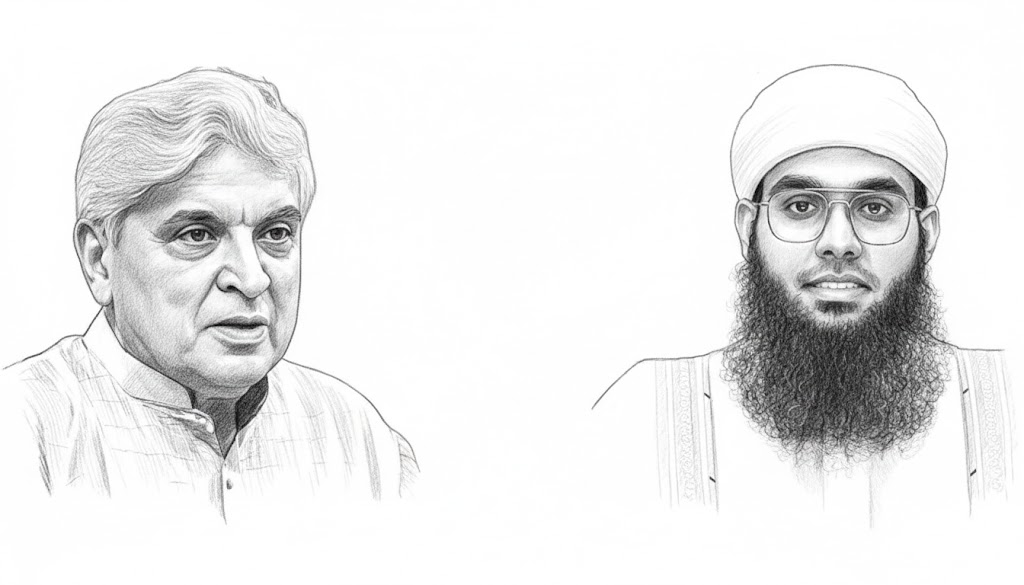

India has always been a land of deep debate. In ancient times, learned scholars engaged in Shastrarath, a traditional form of intellectual discourse. I am glad to see this spirit alive in modern India, most recently in the thoughtful clash between Mufti Shamail Nadwi and Javed Akhtar at the Constitution Club. Their exchange was more than just a disagreement; it was a window into two completely different ways of seeing the world.
The Case for a Necessary Being
Mufti Nadwi built his defense on the Argument from Contingency. He suggested that because our universe is dependent on causes, there must be an independent and Necessary Being at the start of it all to avoid an endless chain of causes. He argued that science is limited to the physical world and simply cannot measure metaphysical realities.
When it comes to the difficult question of suffering, the Mufti viewed it as a divine test. He explained that a Creator’s wisdom is far beyond human perception. He used the beautiful analogy of a child who cries during a painful medical injection, unable to grasp the long term benefit that the medicine provides.
The Problem of Human Suffering
On the other side, Javed Akhtar focused on the Problem of Evil. He questioned how a merciful and all powerful God could allow the horrific suffering of innocent children. To Akhtar, faith often feels like a demand to accept claims without logic. He made a sharp distinction: belief requires proof, while faith often lacks it.
He also challenged the origin of our values. Rather than seeing morality as a gift from heaven, he argued it is a man made traffic rule designed for survival. Just as we drive on a specific side of the road to avoid chaos, he believes we created morality to live together in peace.
Finding Truth in the Experience
This debate reminded me of a moment from my own youth. I once had a similar argument with a friend. I was trying to describe the pure joy nature brings us, while my friend was focused on bookish terms and the technical processes of the world. I realized then that we often use complex, heavy words just to win an argument. However, the truth is found in the joy of the moment, not in the complexity of the language.
The entire debate felt like two people standing in a vast, ancient library. One person argued that the intricate organization of the books proves there must be a Librarian. The other argued that because so many pages are torn and so many stories end in tragedy, the Librarian is either absent or indifferent.
Conclusion: A Universe of Law and Liberty
Ultimately, I believe that God does exist, but perhaps not as a personified figure. Instead, God is a phenomenon that is synonymous with nature itself. This presence does not act on whims but operates through the steady, unbreakable laws of the universe. Within this framework, we have not been left helpless; we have been gifted with free will and common sense to navigate our way through the long voyage of life.
While some find peace in this autonomy, there are still confused masses who feel lost without a specific map. They search for rigid rulebooks to follow, which is exactly what organized religion provides for them. While the scholars debate the existence of a Librarian, I find the truth in the natural laws that govern the library and the personal freedom we have to read the stories as we choose.
While many seek comfort in old rules, I found great inspiration in the fearless energy of Javed Akhtar. At the age of 80 his willingness to step onto the stage and engage in such a rigorous, intellectual challenge is truly inspiring. It was remarkable to see him engage so deeply in this debate, proving that the passion for dialogue remains a powerful force at any age.
0 Comments